Wednesday, March 9, 2011

Land and Construction Loan Requirements

One thing I didn't know much about are the requirements and processes for getting a land or construction loan with a bank. It is similar to the process for getting a home loan, but with a few more restrictions and a lot more paperwork and project management.
  • If you're just purchasing land, you have to get a land loan. These come with high interest rates (4-5% higher than a normal home loan).
  • If you plan to build right away, you can avoid the land loan and get a construction loan. 
  • Construction and land loans require a 20-30% down payment depending on the bank and your finances
  • In order to qualify for a construction loan, you need land, completed plans, a permit from the city, and a contractor in place and ready to go
  • The contractor also has to be approved by the bank. In most cases, this isn't an issue, but the process can take a couple weeks. 
If you don't have everything in place, you can always buy the land first and then roll it into a construction loan later on. This, however, does end up costing more because you have to pay interest on the land and close a second time on a construction loan.

I ended up working with Washington Federal to get my construction loan. 

Tuesday, March 8, 2011

Closing Issues

The closing process ended up not going as smoothly as I would have hoped. In September I found out the title on the land was incorrect because a boundary line adjustment was not filed properly. This meant that the titles on all the adjoining lots needed to be re-appraised and modified. The title company up to 6 months time before the problem was corrected and I could close, but could never give me a definitive date.

Other than the constant uncertainty of when I could close on the land, this meant that I could potentially get all my design and permitting done beforehand and immediately start on construction once the deal closed.

Requirements

The cool part about building a custom home is that it gets to be tailor made for you. In order to give the architects a starting point, they gave me a questionnaire to fill out and also gathered some basic requirements that I wanted out of the house. My list of requirements is obviously very similar to the kind of house I've been looking for:
  • Modern, clean design
  • high ceilings
  • ~1500-1800sq ft
  • large, open living room for entertaining
  • large, well-equipped kitchen with pantry
  • more emphasis on living areas, less emphasis on bedrooms
  • garage for at least 1 car
  • server closet
  • high-tech wiring throughout the house
  • media room or living room that can double as media room
  • low maintenance/upkeep
  • try to use natural materials and finishes
With that information in hand, plus a list of architects and projects that I like, Pb Elemental started on a first draft design of the house.

Thursday, February 10, 2011

Finding Land

Now that I had picked out an architect, the first step was to find some land. Pb Elemental helped me out by pointing me at several available land listings around the Seattle area. There were a few good ones, but nothing that really caught my eye.

It turns out that the search ended rather quickly. About two weeks after I started looking for land, a new listing showed up in the Madrona neighborhood that looked very enticing. The land is located behind two duplexes. It's a large backyard that the owner had subdivided. Here's a satellite view of the lot below:


There's currently a large bush in the middle of the lot and no driveway, but the lot has plenty of potential. It's in a very quiet location, there seems to be ample parking everywhere, and I can see bits of Capitol Hill from the northwest corner of the lot.

Since I know that this is about as good as it's ever going to get in my price range, I put in an offer and reached mutual acceptance within a few days on 7/18/2010.

Sunday, January 9, 2011

The Search For An Architect

After that failed initial foray, I started to think I needed to be a millionaire in order to build a custom home. Luckily, a co-worker of mine recommended an architect, Jim Burton of Blip Design. I met with him at a coffee shop and found out more about his work, the process, and costs. It turns out that it is possible to build something for around $150-180/sq ft.

During my home shopping, I ran into and talked to another architect, David Foster of David Foster Architects. He's done several projects on 22nd st in the central district. I got to walk through the house that he was building and living in and liked many things about it. 

While both of those architects were very nice, I ended up working and signing a contract with Pb Elemental. These are the guys that designed the house that I almost purchased. I chose them over the other architects for the following reasons:
  • I got to walk through some of their buildings and really liked all of their floorplans and clean, no-nonsense layouts with no wasted space. 
  • They are very cost conscious and know how to design something cool on a budget
  • They're very eager and excited to work on new projects. They've only been around for 6 years, so I think they're still in the process of trying to make a name and reputation for themselves. 
  • They're easy to talk to and get along with
If you're ever planning on doing new construction or a remodel, I highly recommend these guys!

Monday, November 29, 2010

A new strategy

After getting over my disappointment with the failed purchase, I began to seriously consider another option: build my own house. I had very little information on where to start or how much a project like that would actually cost, but the idea of it was intriguing to me.

I quickly figured out that the first step is to find an architect. Browsing a few sites like this one, I found out I really liked the work of Olson Kundig Architects. I like their edgy designs and use of natural materials. So I decided to send them an email and find out more about the whole process. I received a prompt and friendly response asking what projects of theirs I liked and my general budget. Excited to be moving forward with something, I sent back an email with a few paragraphs of information that they wanted. As quickly as my exchange started, it stopped. I never received a response back from them after that initial one. Later on, I come to find out that they only talk to people who have lots and lots of money. I'll be sure not to use them when I can afford it.

Sunday, November 14, 2010

Two Opportunities: Part 2

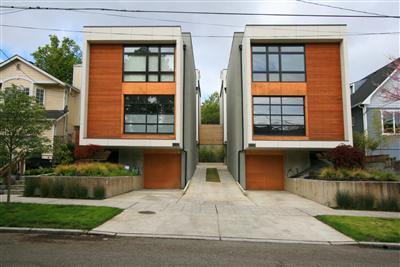
A few months later, in June of 2010, I found a much better house. It's part of a development of 4 free-standing condos designed by Pb Elemental.


The front two and rear two are identical mirrored layouts. The rear-left one was posted for sale for $550K. Here's a picture of what the rear houses look like:

The layout is very clean and open. It has a rooftop deck, high ceilings and lots of nice details. It is also situated in a relatively calm area in the CD. Overall, a very cool property, though the offering price felt high.

I had trouble pricing out the value of the property since, from what I was told, the seller was the builder for the four houses. I did find out that the neighboring mirrored house sold for $575K in 1/2007, close to the peak of the housing market. Doing a little extrapolation using Case-Shiller data for the Seattle market, housing prices dropped about 16% since then. That would price the house out at about $483K. Now since the builder lived in that house, I assume he added some upgrades over the neighboring house, say around $20K worth. That puts the house at $503K. I offered $505K.

Much negotiation followed and I relented on my price. I finally managed to get the sellers to verbally agree to $520K, as long as I do a pre-inspection on the house so that I don't try to squeeze more money out of them. I spent $450 on one the next day and submitted my final counter-offer. Unfortunately, some buyer came in at the last moment with an offer of $541K and bought the house from under me.

This was very disappointing to me, especially since I lost $450, but at least I didn't overpay for the house. I think part of the reason why the house was priced that way was that when agents try to price out a home, they look at nearby comps. At the time, there were two new-construction houses nearby which were extremely overpriced, in the $560-580s. Those must have had an influence on the agent's, and possibly the buyer's pricing decision. Those comparable houses eventually dropped to the low $510-520s and were sold, so it looks like my value assessment was pretty much spot-on.